
Ashland County Court Records After Arrest
After an Ashland County jail arrest, the booking record and the court record serve different jobs. The jail record is created when the person is booked at the Ashland County Jail. It may show the arrest date, holding agency, hold reasons, bond text, and a booking photo. The court record begins when a complaint, information, indictment, or other filing opens a criminal case in the court system. The prosecutor's filed charge can match the roster charge, but it can also be amended, reduced, dismissed, or replaced as the case develops.
The custody side belongs with Ashland County jail inmate records. Booking photos belong with Ashland County jail mugshots. Court records after an arrest are found through Ashland Municipal Court, Ashland County Common Pleas Court, and the Clerk of Courts. Those records are the place to verify charge status, hearings, filings, warrants, bond orders, and final case outcomes.
Find Ashland Court Records After Arrest
Start with the court that matches the charge level. The Ashland Municipal Court handles misdemeanor criminal cases where the maximum punishment is no more than six months in jail and/or a $1,000 fine, plus traffic, parking, and ordinance cases in Ashland County. Felony cases generally move to the Ashland County Common Pleas Court after complaint, preliminary steps, bindover, indictment, or information. The Ashland County Clerk of Courts links online dockets and is the verification point for Common Pleas records.
- Check the jail roster for immediate custody, booking charge text, held-for agency, and bond notes.
- Decide whether the matter is likely Municipal Court or Common Pleas based on misdemeanor, traffic, ordinance, or felony status.
- Search the Ashland Municipal Court GovRec portal for municipal criminal or traffic matters.
- Use the Clerk or Common Pleas online docket links for felony and Common Pleas cases.
- If online data lags, contact the clerk in writing or visit during regular business hours for verified information.
The Clerk's legal disclaimer says online data can lag court filings and judicial action by at least 24 hours and may take longer. It also warns that information can be altered, amended, or modified without notice. That warning is important after a recent jail arrest because the first booking charge may appear before the filed case is fully indexed.
Ashland County Court Record Channels
Several Ashland offices can be involved after an arrest. The correct place depends on charge level and case stage. Court staff can provide public case access and payment guidance, but they do not replace legal advice from an attorney. The prosecutor reviews criminal matters and files or prosecutes charges, while the clerk maintains court filings and docket access.
| Office | Role After Arrest | Contact |
|---|---|---|
| Ashland Municipal Court | Misdemeanor criminal, traffic, parking, and ordinance cases. | 1209 East Main Street, (419) 289-8137, Monday-Friday 8:00 a.m.-4:30 p.m. |
| Ashland County Clerk of Courts | Common Pleas docket access and verified filings. | 142 W. 2nd Street, (419) 282-4242, clerkstaff@ashlandcounty.org. |
| Ashland County Common Pleas Court | Felony and general division criminal case proceedings. | 142 West 2nd Street, (419) 282-4291. |
| Ashland County Prosecutor | Criminal review and prosecution. | 110 Cottage Street, 3rd floor, 419-289-8857. |
The municipal court screenshot below comes from the official court page. The Ashland Municipal Court website is the local source for case lookup and payment links tied to misdemeanor and traffic matters.
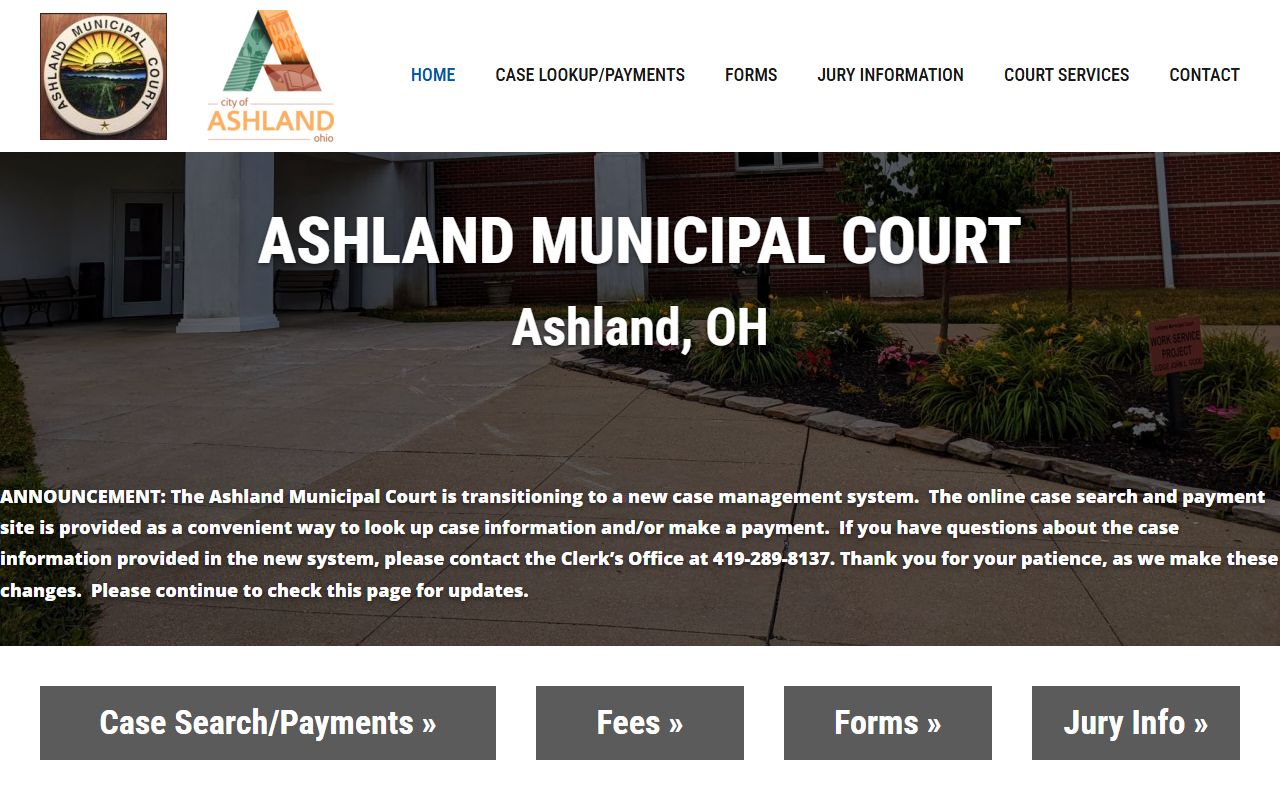
For felony filings, use the Common Pleas and Clerk links, then verify urgent or time-sensitive records with the clerk because online docket data can lag.
Ashland Arrest Charging Documents
Court records after a jail arrest usually start with a charging document. The document name matters because it shows how the case entered court. A complaint often begins a case, especially in municipal or early felony proceedings. An information is filed by the prosecutor where legally permitted. An indictment is returned by a grand jury and is common in felony prosecution.
| Document | Who Uses It | What It Means |
|---|---|---|
| Complaint | Officer, agency, or prosecutor | Starts a criminal case or early charge process after arrest. |
| Information | Prosecutor | Felony charging document used instead of indictment where legally permitted or waived. |
| Indictment | Grand jury | Formal felony charge returned by grand jury for prosecution in Common Pleas Court. |
Ashland Charge Status Terms
A charge listed after booking is an accusation or hold reason. It can change. Prosecutors may amend a charge, dismiss a count, present a felony to a grand jury, or proceed on a different document than the jail roster first suggested. Court records after an Ashland County arrest are the better source for final charge status because they track filings and court orders.
| Status | Meaning |
|---|---|
| Pending | The case or charge remains open. |
| Amended or reduced | The charge changed from the earlier filed or booking version. |
| Dismissed | The charge ended without a conviction on that count. |
| Nolle prosequi | The prosecutor declined or ended prosecution of a charge. |
| Bound over | A felony matter moved from a lower court stage to Common Pleas Court. |
| Indicted | A grand jury returned formal felony charges. |
| Conviction | A final guilty plea or finding on a charge, distinct from arrest or booking. |
Bond After Ashland Jail Arrest
Ashland roster bond text appears inside hold reasons, not as a court-certified bond docket. Public examples in the research included Cash/Surety, Cash Only, Bond Revoked, and $0.00. Multiple charges can have different bond notes, and one hold can block release even when another charge shows an amount. Confirm bond posting rules with the Corrections Division at (419) 281-9009 and then check the court case for certified bond orders.
| Bond Type | How It Works |
|---|---|
| Cash | The required amount is paid directly as ordered by the court or accepted by the jail. |
| Surety | A licensed surety or bond arrangement may be used where the court permits it. |
| Cash/Surety | The roster notation indicates either cash or surety may satisfy that listed bond condition. |
| Personal recognizance | Release based on a promise to appear and follow conditions. |
| No-bond or revoked | Release is blocked because bond is unavailable, revoked, or controlled by another hold. |
Ashland Warrants and Court Records
An official public Ashland sheriff warrant list was not found linked in the same way as the active-inmates page. The Zuercher platform has warrant-module code, but that does not prove Ashland has enabled a public warrant search. If a warrant arrest results in jail custody, the person may appear on the active roster, and the hold reason may describe contempt, warrant-related charges, a protection-order issue, a probation violation, or another court hold.
Bench warrants can originate from Ashland Municipal Court or Ashland County Common Pleas. Use Municipal Court at (419) 289-8137 for municipal matters and the Clerk of Courts Legal Division at (419) 282-4242 for Common Pleas matters. People with active warrants should contact the issuing court or an attorney before appearing in person because an arrest can occur at the courthouse or sheriff's office.
Charges and Convictions Compared
A court record after an arrest can contain both accusations and final outcomes. The distinction matters for background checks, employment questions, housing applications, and personal record review. An arrest and a charge are not a conviction. A conviction requires a guilty plea, verdict, or other final finding accepted by the court.
| Point | Charge | Conviction |
|---|---|---|
| Stage | Accusation filed or listed after arrest. | Final guilty plea or finding. |
| Where seen | Roster hold reasons and court filings. | Final court docket entries and judgment records. |
| Can change | Yes, it can be amended, reduced, dismissed, or replaced. | Can be appealed or later sealed or expunged if eligible. |
| Proof of guilt | No. | Yes, unless later vacated or otherwise changed by court order. |
Sealed and Expunged Records
Ohio Revised Code 2953.32 governs sealing or expungement of eligible conviction and bail-forfeiture records. Sealing and expungement are court processes, not jail-roster buttons. If a record is sealed or expunged, use the court order with the court, clerk, sheriff, or other originating office that controls the record. A dismissed charge can still appear in online or third-party copies until the official record process is complete.
| Term | Public Effect | Where to Start |
|---|---|---|
| Sealed | Hidden from ordinary public access, with limited lawful access remaining. | The court that has the case. |
| Expunged | Treated as removed or destroyed to the extent Ohio law permits. | The court and statute-based eligibility process. |
| Dismissed | The charge ended without conviction, but the record is not automatically gone. | Check the docket, then ask the court about sealing or expungement eligibility. |
Restricted Ashland Arrest Records
Not every record tied to an arrest is public in full. Juvenile information is restricted in the roster configuration. Active investigative material, sealed records, exempt personal information, and some victim or witness details may be withheld or redacted under Ohio public-records law. The sheriff records unit and court clerk can explain whether a specific requested record exists, whether it is public, and whether redactions apply.
Important: Do not use court records after an Ashland County arrest for FCRA-covered decisions without a lawful consumer-reporting process.
Public Record Search
Sponsored Results